
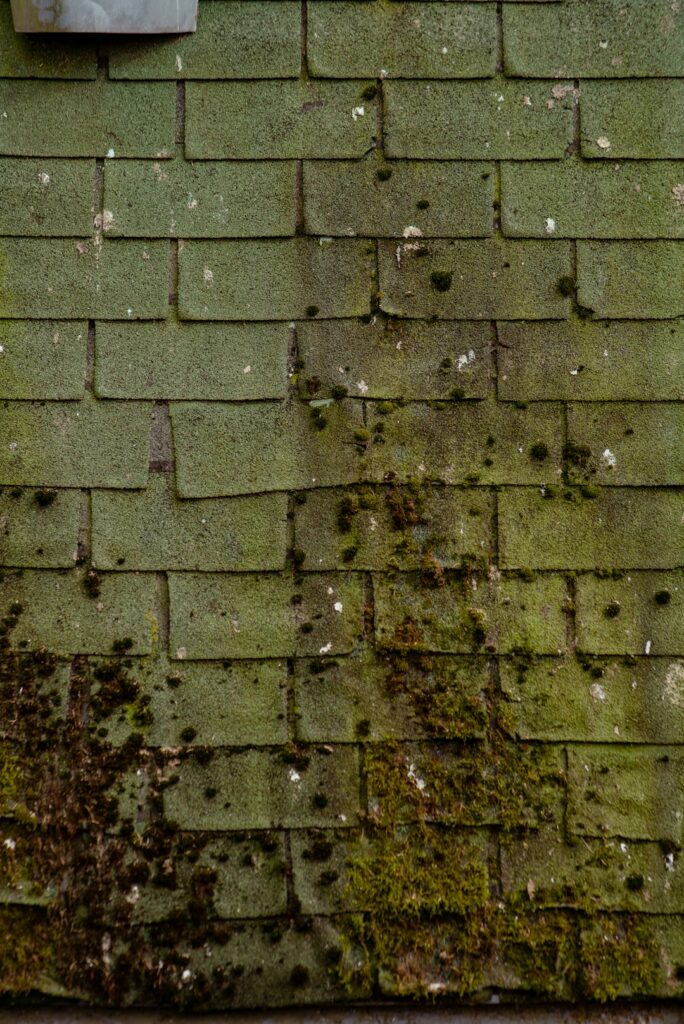
Why do moss and algae grow on roofs?
Moss and algae grow when a roof stays damp for long periods and receives limited direct sunlight. In Le Roy, NY, repeated wet weather, snow cover, shaded yards, and spring or autumn leaf buildup can create conditions where roof surfaces dry slowly.
Algae often appears as dark green, brown, or black streaks. Moss is thicker and more plant-like, forming soft green patches or raised mats. Neither problem should be ignored, because growth can hold moisture against roofing materials and may interfere with water drainage.
Roof growth is more common on:
- North-facing or heavily shaded roof slopes
- Roofs beneath mature trees
- Areas where leaves and pine needles collect
- Low-slope sections that dry slowly
- Older roofs with worn or roughened surfaces
- Roofs near clogged or poorly draining gutters
The presence of moss or algae does not automatically mean the entire roof must be replaced. The correct response depends on the type of growth, how long it has been present, the condition of the shingles, and whether water is entering the building.
Is moss more damaging than algae?
Moss generally creates a greater physical risk than surface algae. Algae mainly changes the roof’s appearance, while moss can grow beneath shingle edges, lift roofing materials, and retain moisture against the surface.
As moss expands, its root-like structures may work into small gaps between shingles. During freezing weather, trapped moisture can expand and contract repeatedly. That process may contribute to loose granules, curled edges, cracked shingles, or weakened areas.
Algae can still be a sign that a roof remains damp for extended periods. Dark streaks may also make it harder to identify other roof problems, such as staining around penetrations, damaged flashing, or areas where water does not drain correctly.
Moss and algae are not the same as mold. Mold typically grows on organic materials and may appear in attic spaces or on damp interior surfaces. Roof moss and algae are usually exterior growth problems, although persistent roof moisture can contribute to broader water-related damage.
What should be done first?
The first step is a careful visual assessment from the ground or from a safely accessible location. Look for the extent of the growth, nearby tree coverage, clogged gutters, missing shingles, lifted shingle edges, and stains on siding or soffits.
Avoid walking on a roof covered with moss. The surface may be slippery, and walking can break granules from asphalt shingles or damage brittle roofing materials. Ladders also become more hazardous when roof edges, gutters, or surrounding ground are wet.
Check the attic after heavy rain if the home has an accessible attic space. Dark roof sheathing, damp insulation, musty odors, or daylight visible through the roof deck can indicate a moisture problem that requires more than cleaning.
If shingles are badly deteriorated, the roof has active leaks, or safe access is not possible, evaluation by a qualified roofing professional may be necessary. This is especially true for steep roofs, roofs with multiple levels, or surfaces near overhead utility lines.
How can moss and algae be removed safely?
Removal should be gentle. Scraping, pressure washing, and harsh brushing can remove protective granules from asphalt shingles and shorten the useful life of the roof.
A common approach is to apply a roofing-safe cleaning solution according to its label directions, allow it to work, and let weather gradually loosen the growth. Some treatments require repeated applications rather than immediate removal. The exact product and dilution matter, because concentrated chemicals can damage roofing, plants, siding, painted surfaces, or metal components.
Avoid:
- Pressure washing asphalt shingles
- Using a stiff wire brush
- Pulling moss from beneath shingle edges
- Applying undiluted bleach or strong acids
- Allowing runoff to enter ponds, gardens, or storm drains
- Standing on wet or steep roof surfaces
Any vegetation below the roof should be watered before and after some cleaning treatments if the product instructions call for it. Downspouts should be directed away from foundation walls, and chemical runoff should be controlled rather than allowed to flow freely across landscaping.
Moss may leave behind dead, discolored material after treatment. That does not necessarily mean the treatment failed. The remaining material may gradually wash away with rain, but large mats should not be forcibly torn from the roof.

Do zinc or copper strips prevent regrowth?
Metal strips installed near the roof ridge can help reduce future moss and algae growth. Rainwater carries small amounts of metal across the roof, creating a less favorable surface for some organisms.
These strips are not a complete solution. They work best when installed correctly and when the roof can be rinsed by rainfall. Heavy shade, leaf cover, roof debris, and persistent moisture can limit their effectiveness. Metal runoff may also affect plants and soil below the roof edge.
Existing growth usually needs to be treated separately. A strip will not instantly remove established moss, and it cannot repair shingles that have already been lifted or damaged.
Any fasteners or installation method must be compatible with the roofing materials. Improperly placed metal can create openings around the ridge or interfere with ventilation components.
How can homeowners reduce future growth?
The most effective prevention measures reduce moisture and increase airflow without damaging the roof.
Keep gutters and downspouts clear so water does not back up beneath shingles or remain near roof edges. Remove accumulated leaves and branches using methods that do not drag debris across the roof surface. Tree limbs that heavily shade the roof may be selectively trimmed, but pruning should not create a safety hazard or harm the tree.
Other useful steps include:
- Improving attic ventilation when moisture is building up indoors
- Confirming that bathroom and kitchen exhaust vents discharge outdoors
- Keeping roof valleys and drainage paths free of debris
- Correcting overflowing gutters or disconnected downspouts
- Watching shaded roof sections after long periods of rain
- Inspecting the roof after winter and again in late autumn
In the local freeze-and-thaw climate, prevention matters because moisture can remain trapped beneath snow, leaves, and moss before freezing overnight. A roof that appears stable during summer may show lifted shingles or leaking points after several seasonal cycles.
When does moss or algae indicate a larger roof problem?
Growth deserves closer attention when it appears alongside leaking, sagging, missing shingles, exposed underlayment, rusted flashing, or interior water stains. Moss concentrated in one area may point to a drainage issue, a shaded low spot, or a roof detail that allows water to remain in place.
A few algae streaks on otherwise sound shingles may be primarily cosmetic. Thick moss covering broad sections, however, can conceal damage and make the roof surface unsafe to inspect.
The age of the roofing also matters. Cleaning a roof with substantial remaining service life may be reasonable, while an older roof with brittle shingles may be damaged by attempted removal. Cleaning should not be used to disguise a roof that is already failing.
Regular ground-level checks, especially in spring and after leaf fall, can identify growth before it spreads. Addressing the moisture conditions that support moss and algae is usually more effective than repeatedly removing the visible growth alone.
